
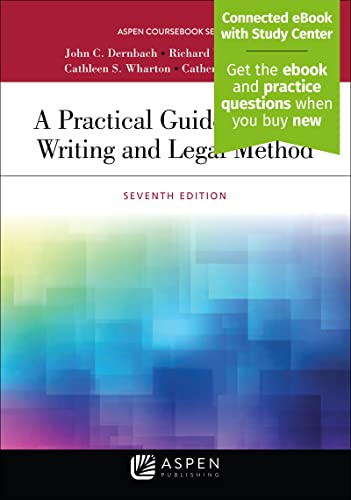
Coursebooks · 7th edition
A Practical Guide to Legal Writing and Legal Method - 7th edition - Dernbach
Product details
Description
A Practical Guide to Legal Writing and Legal Method ISBN 9781543825237 remains one of the most trusted and widely used resources in legal education, offering comprehensive instruction on both the theory and practice of legal analysis and communication. Known for its clarity, depth, and practical orientation, this classic text equips students with the essential tools needed to succeed in law school and legal practice.
The book’s accessible explanations, real-world examples, and targeted exercises help students develop the core competencies of legal writing and reasoning—whether they are preparing an office memorandum, writing for a court, or delivering an oral argument. Designed to support classroom instruction as well as independent study, this guide also serves as an invaluable desk reference for graduates entering the legal profession.
New to the Seventh Edition:
-
A reorganized structure that emphasizes the core themes and logic of legal analysis throughout.
-
Consolidated chapters that streamline key concepts, making the material even more approachable for both students and instructors.
-
An expanded appendix on professional email communications in legal settings.
Key Benefits for Professors and Students:
-
Clear, accessible introductions to core topics in legal method and writing.
-
Side-by-side examples of effective and ineffective writing to illustrate common pitfalls and best practices.
-
Focused exercises at the end of each chapter to reinforce the material and encourage hands-on learning.
-
Comprehensive guidance on:
-
Reading and interpreting statutes and case law.
-
Synthesizing legal authorities.
-
Applying rules to specific facts.
-
Organizing and drafting objective and persuasive legal analysis.
-
-
Instruction on various legal documents, including:
-
Office memoranda (traditional and email format).
-
Client letters and opinion letters.
-
Trial court briefs and appellate briefs.
-
Short summaries of law for time-sensitive situations.
-
-
Integrated discussion of professional responsibility and ethical considerations throughout the writing process.
-
Modern guidance on electronic communication, including when and how to use email effectively in professional legal contexts.
Bonus:
The appendices include a complete sample case file featuring example memos, client communications, and court briefs—ideal for practice, comparison, and classroom use.
Whether you're teaching a full legal writing course or preparing students for summer internships and externships, A Practical Guide to Legal Writing and Legal Method offers a proven, flexible foundation for building essential legal communication skills.
A Practical Guide to Legal Writing and Legal Method ISBN 9781543825237
Details
- ISBN
- 9781543825237
- Edition
- 7th edition
- Publisher
- Aspen Publishing
- Publication Date
- November 2023
Condition Guide
Every FrugalText book is graded by our receiving team before it ships. Conditions describe cosmetic state only - content is identical across tiers.
-
Acceptable
Readable throughout. Expect highlighting, margin notes, and wear on cover or spine. Best price for the same page numbers.
-
Good
Minor highlighting or notes. All pages intact. Cover shows light shelf wear.
-
Very Good
Little to no writing. Binding tight. Looks barely used.
-
Brand New
Unused and unmarked. Shrinkwrapped when available from the publisher.
-
Brand New + eBook
Brand new print copy plus the publisher's eBook and supplemental digital access, where offered.
Shipping & Returns
-
Fast, standard shipping
Most students receive their books in 3 to 9 business days.
-
Rental returns: free at semester's end, prorated if early
Print a prepaid return label from your account whenever you have finished with the book, and drop it at the carrier listed on the label. Returning it by your semester return date, or after it is already overdue, is free with no deduction. Returning it early, before that date, deducts a 15% restocking fee and the label cost from your refund.
-
Purchase returns: 15% restocking fee
Purchases can be returned within 30 days in the condition you received. We will email a prepaid return label; once we receive your book, we refund the purchase price minus the 15% restocking fee and the return label cost. Original shipping is non-refundable.
-
Shipping costs calculated at checkout
Real-time rates are quoted at checkout based on your address and the books in your cart. Returning your book by your semester date is always free; an early return deducts the restocking fee and label cost from your refund instead.
Rental Terms
Return by December 28, 2026 for Fall 2026 rentals.
- Late Fees
- Books returned after the semester deadline accrue a weekly late fee of about 10% of the book's Brand New price, for each copy that is overdue. The rent you have already paid counts toward the book's replacement value (its Brand New price), so late fees stop once your rent plus late fees reach it. That replacement value is the most a rental can ever cost you. We email a reminder 48 hours before any charge, and any late fees are charged to the payment method you save at checkout.
- Damage Fees
- Books returned damaged beyond normal classroom wear may be assessed a damage fee, capped at the book's replacement value (its Brand New price). Any damage fees are charged to the payment method you save at checkout after we inspect the returned book.
- Return Shipping
- Returning your book is free with no deduction if it reaches us by your semester return date, or after it's already overdue. Print a prepaid label (USPS or UPS, whichever is cheaper for your package) from your account's My Rentals page. Returning it EARLY, before your semester return date, deducts a 15% restocking fee and the label cost from your refund, the same as cancelling a shipped rental for a refund.
- 30-Day Cancellation
- Changed your mind? Cancel an active rental within 30 days of your order from My Account → My Rentals. Cancel before your book ships and it’s free; once it has shipped, we refund the rental price minus a 15% restocking fee and the return label cost, released once we receive your book. Shipping is non-refundable.
You might also need
Students also rent these.
-
West Academic
Legal Writing Style (Hornbooks)
Buy from $59.99
1 condition -
West Academic
Advanced Legal Writing and Oral Advocacy: Trials, Appeals,…
Rent from $70.84
2 conditions -
West Academic
Legal Writing, A Contemporary Approach (Interactive Caseboo…
Rent from $35.11
2 conditions -
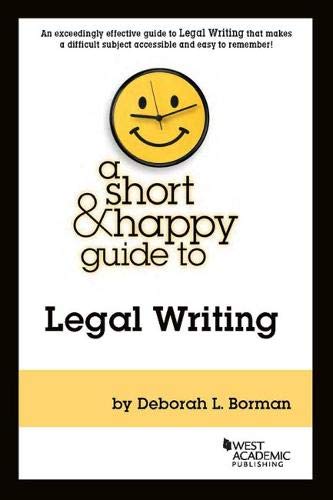
West Academic
A Short & Happy Guide to Legal Writing (Short & Happy Guide…
Buy from $24.92
1 condition -

West Academic
Practical Legal English: Writing as a U.S. Lawyer (Coursebo…
Buy from $48.88
1 condition -

West Academic
Legal Writing: From Advice to Advocacy, A Contemporary Appr…
Buy from $68.01
1 condition