
Uncategorized
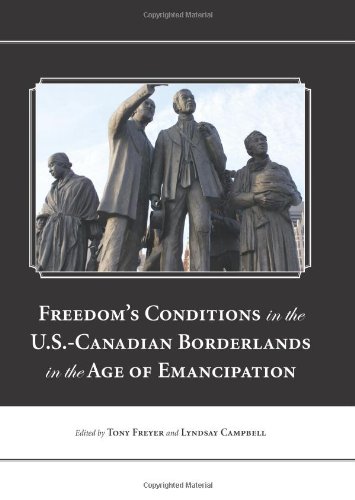
Freedom's Conditions in the U.S.-Canadian Borderlands in the Age of Emancipation
Product details
Description
Product Description In Freedom's Conditions in the U.S.-Canadian Borderlands in the Age of Emancipation, American and Canadian legal historians explore the operation of race in the borderlands in the mid-nineteenth century. The contributors Tony Freyer, Lyndsay Campbell, Aviam Soifer, Gautham Rao, John Wertheimer, Stephen Middleton, and Bradley Miller examine the shadows that legal regimes cast upon each other, as people of African descent, and others, made decisions to move from one place to another in search of better, freer conditions under which to live, work, and raise their families. Legal institutions struggled with commitments to preserving states' rights to govern their own people, to popular sovereignty, to freedom of contract, to liberal ideals of equality and comity, and of course to white supremacy. Tensions ran high among different levels of government - federal-state-local in the United States and imperial-colonial-local in British North America. On the ground, practices of governance, such as policing and slave-catching, were unevenly professionalized: on both sides of the international border, low-level officials without much legal training and vested with considerable discretion were essential state actors. This collection is aimed at both American and Canadian readers interested in the histories of race, inter-state relations, and the development of legal institutions. The introduction and conclusion, by Freyer and Campbell, frame the essays and identify unifying themes and overlapping conclusions. As a whole, the essays in this collection make clear the hope that Canadian legal institutions offered to African Americans: formal equality, though in practice discrimination took place in the implementation of law, through racializing habits that affected exercises of discretion by various state officials. In the United States, the Fugitive Slave Act of 1850, combined with the influx of Irish immigrants in the late 1840s, provoked sharp, tense conflicts over the racialized governance of human mobility in the northern states, conflicts that, ironically, carved out a space for greater rights and autonomy for African Americans even as the fault lines in American federalism deepened. These essays also cast light on the fundamental instabilities in a legal system that accommodated slavery and explicitly entrenched white supremacy. About the Author Tony Freyer is a University Research Professor of History and Law at the University of Alabama School of Law. Lyndsay Campbell is an Assistant Professor in the Faculties of Law and Arts at the University of Calgary, Canada, and coordinator of the undergraduate Law and Society Program.
Details
- ISBN
- 9781594607721
- Publisher
- Carolina Academic Press
- Publication Date
- October 2023
Condition Guide
Every FrugalText book is graded by our receiving team before it ships. Conditions describe cosmetic state only - content is identical across tiers.
-
Acceptable
Readable throughout. Expect highlighting, margin notes, and wear on cover or spine. Best price for the same page numbers.
-
Good
Minor highlighting or notes. All pages intact. Cover shows light shelf wear.
-
Very Good
Little to no writing. Binding tight. Looks barely used.
-
Brand New
Unused and unmarked. Shrinkwrapped when available from the publisher.
-
Brand New + eBook
Brand new print copy plus the publisher's eBook and supplemental digital access, where offered.
Shipping & Returns
-
Fast, standard shipping
Most students receive their books in 3 to 9 business days.
-
Rental returns: free at semester's end, prorated if early
Print a prepaid return label from your account whenever you have finished with the book, and drop it at the carrier listed on the label. Returning it by your semester return date, or after it is already overdue, is free with no deduction. Returning it early, before that date, deducts a 15% restocking fee and the label cost from your refund.
-
Purchase returns: 15% restocking fee
Purchases can be returned within 30 days in the condition you received. We will email a prepaid return label; once we receive your book, we refund the purchase price minus the 15% restocking fee and the return label cost. Original shipping is non-refundable.
-
Shipping costs calculated at checkout
Real-time rates are quoted at checkout based on your address and the books in your cart. Returning your book by your semester date is always free; an early return deducts the restocking fee and label cost from your refund instead.
You might also need
Students also rent these.
-

American Bar Association
The American Bar Association's Legal Guide to Independent F…
Buy from $45.95
1 condition -

American Bar Association
The Advisor's Guide to Life Insurance
Buy from $82.75
1 condition -

American Bar Association
The Practice: Brutal Truths About Lawyers and Lawyering
Buy from $24.79
1 condition -

American Bar Association
Manual of Style for Contract Drafting
Buy from $68.95
1 condition -

American Bar Association
How to Build and Manage a Personal Injury Practice
Buy from $64.35
1 condition -

American Bar Association
Truck Accident Litigation, Third Edition
Buy from $137.95
1 condition