
Uncategorized
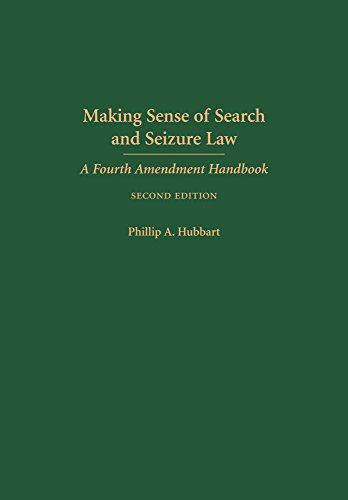
Making Sense of Search and Seizure Law: A Fourth Amendment Handbook
Product details
Description
To view or download the 2021 supplement to this book, click here.
Making Sense of Search and Seizure Law: A Fourth Amendment Handbook is the best one volume treatment of Fourth Amendment law in print. Competing works are sprawling, and often multi-volume, encyclopedic treatments of the subject. This book is easy to follow and makes sense of the subject in a way that readers can quickly grasp. The primary purpose of the book is to restate existing up-to-date Fourth Amendment law, as announced by the over 430 U.S. Supreme Court decisions on the subject, in an organized and lucid manner, true to its historical origins.
The book is divided into two parts: Part I, The Historical Background and Purpose of the Fourth Amendment; and Part II, The Substantive Law of the Fourth Amendment. Part I contains 6 chapters, including an in-depth discussion of the historical background that led to the adoption of the Fourth Amendment [1761-1791] — not the cursory historical treatment usually found in competing works. These chapters show how this historical background has heavily influenced the development of Fourth Amendment case law, as well as how central the Fourth Amendment is to our country's development and traditions. Part II has an introductory chapter on constitutional construction, and is then divided into three subparts covering 10 chapters: Subpart A, The Standing Requirement; Subpart B, The Unreasonableness Requirement; and Subpart C, Enforcement of the Fourth Amendment.
Making Sense of Search and Seizure Law is designed for practicing lawyers and judges for use in their professional work, as well as law professors who teach Fourth Amendment law and wish to place a copy or multiple copies of the book on reserve as outside reading for their students. The general reader should also find it of interest —particularly the historical chapters.
Details
- ISBN
- 9781611636154
- Publisher
- Carolina Academic Press
- Publication Date
- October 2023
Condition Guide
Every FrugalText book is graded by our receiving team before it ships. Conditions describe cosmetic state only - content is identical across tiers.
-
Acceptable
Readable throughout. Expect highlighting, margin notes, and wear on cover or spine. Best price for the same page numbers.
-
Good
Minor highlighting or notes. All pages intact. Cover shows light shelf wear.
-
Very Good
Little to no writing. Binding tight. Looks barely used.
-
Brand New
Unused and unmarked. Shrinkwrapped when available from the publisher.
-
Brand New + eBook
Brand new print copy plus the publisher's eBook and supplemental digital access, where offered.
Shipping & Returns
-
Fast, standard shipping
Most students receive their books in 3 to 9 business days.
-
Rental returns: free at semester's end, prorated if early
Print a prepaid return label from your account whenever you have finished with the book, and drop it at the carrier listed on the label. Returning it by your semester return date, or after it is already overdue, is free with no deduction. Returning it early, before that date, deducts a 15% restocking fee and the label cost from your refund.
-
Purchase returns: 15% restocking fee
Purchases can be returned within 30 days in the condition you received. We will email a prepaid return label; once we receive your book, we refund the purchase price minus the 15% restocking fee and the return label cost. Original shipping is non-refundable.
-
Shipping costs calculated at checkout
Real-time rates are quoted at checkout based on your address and the books in your cart. Returning your book by your semester date is always free; an early return deducts the restocking fee and label cost from your refund instead.
Rental Terms
Return by December 28, 2026 for Fall 2026 rentals.
- Late Fees
- Books returned after the semester deadline accrue a weekly late fee of about 10% of the book's Brand New price, for each copy that is overdue. The rent you have already paid counts toward the book's replacement value (its Brand New price), so late fees stop once your rent plus late fees reach it. That replacement value is the most a rental can ever cost you. We email a reminder 48 hours before any charge, and any late fees are charged to the payment method you save at checkout.
- Damage Fees
- Books returned damaged beyond normal classroom wear may be assessed a damage fee, capped at the book's replacement value (its Brand New price). Any damage fees are charged to the payment method you save at checkout after we inspect the returned book.
- Return Shipping
- Returning your book is free with no deduction if it reaches us by your semester return date, or after it's already overdue. Print a prepaid label (USPS or UPS, whichever is cheaper for your package) from your account's My Rentals page. Returning it EARLY, before your semester return date, deducts a 15% restocking fee and the label cost from your refund, the same as cancelling a shipped rental for a refund.
- 30-Day Cancellation
- Changed your mind? Cancel an active rental within 30 days of your order from My Account → My Rentals. Cancel before your book ships and it’s free; once it has shipped, we refund the rental price minus a 15% restocking fee and the return label cost, released once we receive your book. Shipping is non-refundable.
You might also need
Students also rent these.
-

American Bar Association
A Lawyer's Journey: The Morris Dees Story
Buy from $35.88
1 condition -

American Bar Association
Global Climate Change and U.S. Law
Buy from $55.15
1 condition -

American Bar Association
Nonprofit Governance and Management
Buy from $101.15
1 condition -

American Bar Association
The Advisor's Guide to Life Insurance
Buy from $82.75
1 condition -

American Bar Association
How to Build and Manage a Personal Injury Practice
Buy from $64.35
1 condition -

American Bar Association
The Practice: Brutal Truths About Lawyers and Lawyering
Buy from $24.79
1 condition