

Legal Method
Legal Methods: Understanding and Using Cases and Statutes, 3d (University Casebook Series)
Product details
Description
How should students begin their legal education? Professor Peter Strauss's innovative materials build on a Columbia Law School commitment reaching back to Karl Llewellyn's Bramble Bush—that legal education should start with orientation to the materials lawyers use and the institutions they deal with.
Like its predecessors, the third edition builds both case analysis and statutory interpretation skills, with an increasing emphasis on the latter. After a general introduction, four chapters deal with three historical stages in American legal development Karl Llewellyn and Grant Gilmore had identified—"Discovery" at the nation's beginnings; "Faith" as judges turned formalist in the late Nineteenth Century; "Anxiety" as progressive legislation challenged judges and legal realism emerged —and "Modern Times," the current day. Each chapter presents both case and statutory materials—simple at first and gradually becoming more complex, with statutes increasingly dominating.
The first three of these chapters, "Discovery," "Faith," and "Anxiety," follow the development of product liability law, wholly a common law matter, and workplace injury law, which begins in the courts and is displaced by statutes. The distribution of authority between federal and state courts, that begins with Swift v. Tyson and ends with Erie RR v. Thomson, is a secondary theme. That displacement is signaled, for teaching purposes, by the Railroad Safety Appliances Act of 1893. Innovative teaching materials reflect the realities of law practice by engaging the students with practical problems the railroads were required to solve, legislative materials they would have been attentive to, and Interstate Commerce Commission reports on the negotiated implementation of the Act, hours before they encounter the first judicial dealings with its interpretation. That they will quickly reach an understanding of the statute that initially eludes the judges is, in itself, an important lesson.
"Modern Times," brings product liability developments through the ALI's Third Restatement of Torts. On the statutory side, a unit on litigation fee reimbursement, structured along the same lines as the Railway Safety Appliances Act materials, engages students in contemporary congressional materials and lawyers' briefs, in the courts' increasing struggles over interpretive technique, and in the difficulties of contemporary legislative-judicial "conversation. The interpretive debate is then revisited in extensive passages from the writings of Judge Stephen Breyer, purposivist, and John Manning, textualist, supplemented by many shorter excerpts from the literature. The chapter ends by setting three interpretive problems for students to resolve for themselves before turning the page to discover how the Supreme Court very recently resolved them. In proceeding from the early 19th Century to the greater complexities of the current day, then, the casebook explores the sources, forms, and development of law, the analysis and synthesis of judicial precedents, the interpretation of statutes, the coordination of judge-made and statute law, and the uses of legal reasoning. Understanding that today's lawyer must often deal with transactions governed by the civil law, the dominant legal system in much of the rest of the world, the casebook attempts briefly to expose the student to its development as well.
With this casebook, a student will have acquired skills essential to work in other law school classes, an appreciation for the changing styles of legal analysis that American jurists have brought to their work over time, and an awareness of current disputes about the modern role of judges, particularly in relation to the work of legislatures.
Details
- ISBN
- 9781609301996
- Publisher
- West Academic
- Publication Date
- October 2023
Condition Guide
Every FrugalText book is graded by our receiving team before it ships. Conditions describe cosmetic state only - content is identical across tiers.
-
Acceptable
Readable throughout. Expect highlighting, margin notes, and wear on cover or spine. Best price for the same page numbers.
-
Good
Minor highlighting or notes. All pages intact. Cover shows light shelf wear.
-
Very Good
Little to no writing. Binding tight. Looks barely used.
-
Brand New
Unused and unmarked. Shrinkwrapped when available from the publisher.
-
Brand New + eBook
Brand new print copy plus the publisher's eBook and supplemental digital access, where offered.
Shipping & Returns
-
Fast, standard shipping
Most students receive their books in 3 to 9 business days.
-
Rental returns: free at semester's end, prorated if early
Print a prepaid return label from your account whenever you have finished with the book, and drop it at the carrier listed on the label. Returning it by your semester return date, or after it is already overdue, is free with no deduction. Returning it early, before that date, deducts a 15% restocking fee and the label cost from your refund.
-
Purchase returns: 15% restocking fee
Purchases can be returned within 30 days in the condition you received. We will email a prepaid return label; once we receive your book, we refund the purchase price minus the 15% restocking fee and the return label cost. Original shipping is non-refundable.
-
Shipping costs calculated at checkout
Real-time rates are quoted at checkout based on your address and the books in your cart. Returning your book by your semester date is always free; an early return deducts the restocking fee and label cost from your refund instead.
You might also need
Students also rent these.
-
West Academic
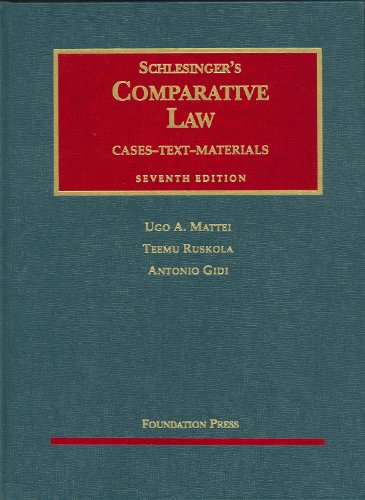
Schlesinger's Comparative Law: Cases, Text, Materials, 7th…
Buy from $268.00
1 condition -

West Academic
Higher Education and the Law, 2d (University Casebook Serie…
Buy from $268.00
1 condition -

West Academic
Payments and Credits (University Casebook Series)
Buy from $165.60
1 condition -

West Academic
Christian Legal Thought: Materials and Cases (University Ca…
Buy from $268.00
1 condition -

West Academic
Racial Justice and Law, Cases and Materials (University Cas…
Rent from $161.14
2 conditions -

West Academic
Sentencing Law and Policy (University Casebook Series)
Buy from $268.00
1 condition